How AI Is Changing Everyday Life in South Africa
Artificial intelligence once sounded like something belonging to science-fiction films.
Today, it is increasingly part of everyday life.
In South Africa, people are using AI through smartphones, search engines, banking platforms, business software, education tools and social-media applications — often without thinking about how much technology is working behind the scenes.
The growth of AI in South Africa is creating exciting possibilities, but it is also raising important questions about jobs, privacy, skills and the future of work.
AI is becoming an everyday tool
One of the biggest changes is that artificial intelligence is no longer limited to large technology companies.
A small business owner can use AI to help draft marketing material.
A student can use it to understand a difficult concept.
A freelancer can use AI tools to brainstorm ideas.
A customer can interact with an automated support system.
A content creator can use AI-assisted tools during research, editing or production.
The technology is becoming another tool in the digital toolbox.
But using it effectively requires understanding what it can — and cannot — do.
Small businesses could benefit significantly
For South Africa’s small-business sector, AI could become particularly valuable.
Many small companies operate with limited staff.
One person may handle administration, marketing, customer communication and sales.
AI can assist with some repetitive tasks, giving entrepreneurs more time to concentrate on customers and the actual running of their businesses.
It can help organise information, generate initial ideas, analyse documents and assist with routine communication.
That doesn’t mean entrepreneurs should hand their businesses over to AI.
Human judgement remains essential.
A computer can produce an answer.
The business owner still has to decide whether that answer makes sense.
Education is entering a new phase
AI is also changing the way people learn.
Students can ask questions in conversational language and receive explanations tailored to their level of understanding.
Teachers can use digital tools to develop lesson ideas, create exercises and explore different ways of explaining concepts.
But there is a major difference between using AI to learn and using AI to avoid learning.
If a student simply copies an AI-generated answer, they may finish an assignment without understanding the subject.
Used properly, however, AI can act more like a study assistant.
It can explain.
It can provide examples.
It can ask questions.
And it can help learners identify areas they don’t understand.
The workplace is changing
The impact on employment is likely to be one of the biggest conversations surrounding AI.
Some tasks that previously required significant amounts of human time can now be automated or accelerated.
That could affect administrative work, customer service, data processing, marketing and other areas.
But technological change doesn’t necessarily mean that every job disappears.
History shows that new technologies often eliminate some tasks while creating new ones.
The bigger question may therefore be:
What skills will people need as AI becomes more capable?
Digital literacy will become increasingly important.
So will creativity, communication, critical thinking, problem-solving and the ability to work alongside technology.
South Africa needs AI skills
Technology doesn’t create opportunities equally.
People need access to devices, connectivity, education and training if they are going to benefit from the AI economy.
That makes digital skills development particularly important.
Young South Africans entering the workforce need to understand not only how to use AI tools but how these systems work, where they can fail and how information should be evaluated.
Businesses also need employees who can identify practical applications rather than simply adopting AI because it is fashionable.
The companies that benefit most may be those that use AI to solve genuine problems.
Creativity isn’t disappearing
There are understandable concerns among photographers, writers, designers, musicians and other creatives about artificial intelligence.
AI can generate images.
It can produce text.
It can create music.
It can edit videos.
But creativity is about more than producing an output.
It is about perspective.
Culture.
Experience.
Emotion.
Taste.
Storytelling.
South Africa has an enormous cultural diversity that cannot simply be reduced to a database of prompts.
The opportunity for local creators may therefore be to use AI as an additional tool while retaining the human perspective that makes their work distinctive.
Privacy matters
As people use more AI-powered services, privacy becomes increasingly important.
Users should think carefully about the information they share with digital tools.
Personal information, confidential business documents, financial details and private conversations should not automatically be uploaded simply because an AI service makes it possible.
Technology companies also have a responsibility to explain how information is collected and used.
Trust will become one of the most important issues in the AI era.
AI won’t replace human judgement
Perhaps the most useful way to think about artificial intelligence is not as a replacement for people, but as a tool that can extend what people are capable of doing.
A doctor still needs medical judgement.
A teacher still understands their students.
A business owner still understands their customers.
A journalist still needs to verify information.
A designer still needs creative direction.
AI can assist with parts of these processes, but responsibility remains with people.
That distinction matters.
The opportunity for Mzansi
South Africa has an opportunity to become more than a consumer of artificial intelligence.
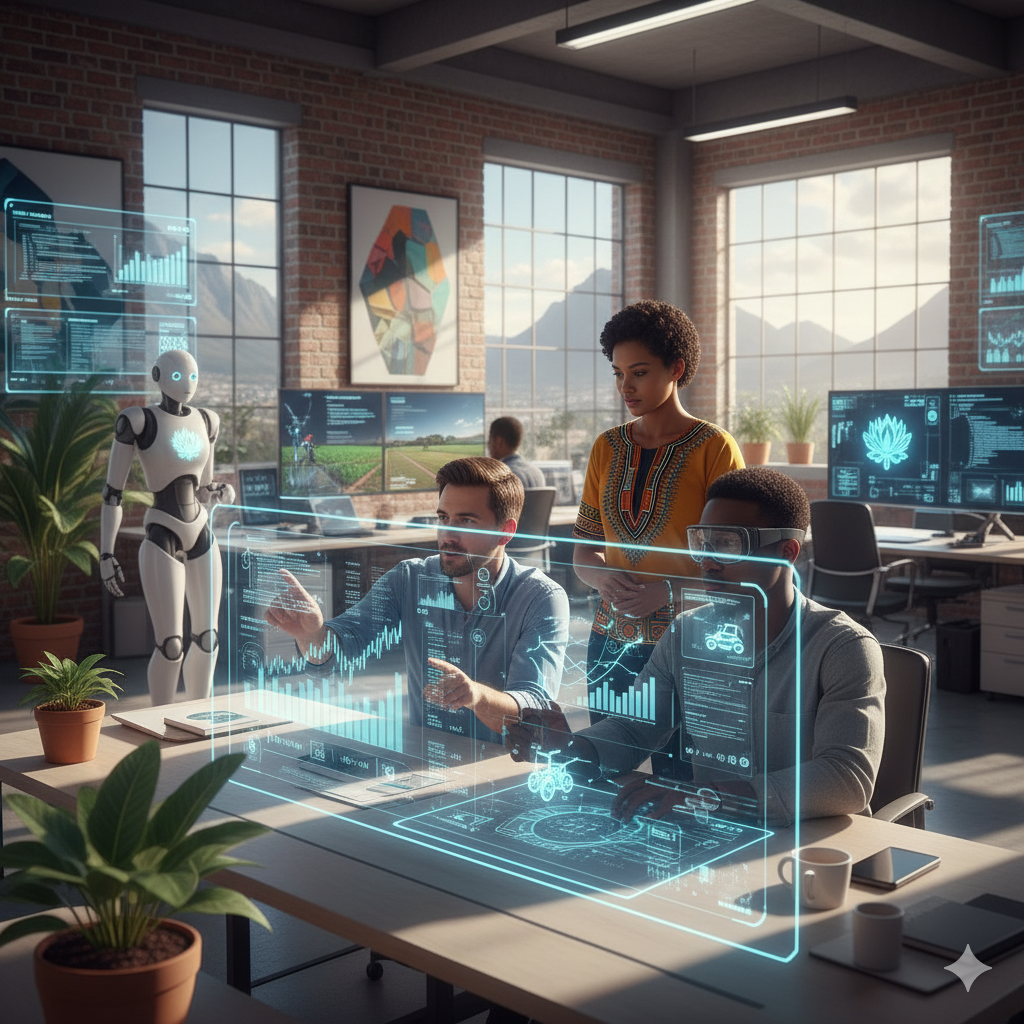
The country has talented developers, entrepreneurs, researchers, creatives and technology professionals who can build solutions specifically for African markets.
That could include tools designed around local languages, financial inclusion, education, agriculture, healthcare, transport and small-business development.
The biggest opportunities may not come from copying technology created elsewhere.
They may come from solving problems that are uniquely African.
The next digital chapter
Artificial intelligence is still developing.
Some predictions about it will prove correct.
Others will not.
What is already clear is that AI is becoming part of the digital environment in which South Africans live and work.
The people who benefit most will probably not be those who blindly embrace every new AI tool.
They will be the ones who understand its strengths, recognise its weaknesses and know when human judgement matters most.
For Mzansi, that means the AI conversation shouldn’t only be about technology.
It should also be about people, skills, opportunity and inclusion.
Because the real question isn’t whether artificial intelligence will change South Africa.
It already is.
The question is what South Africans choose to build with it.